



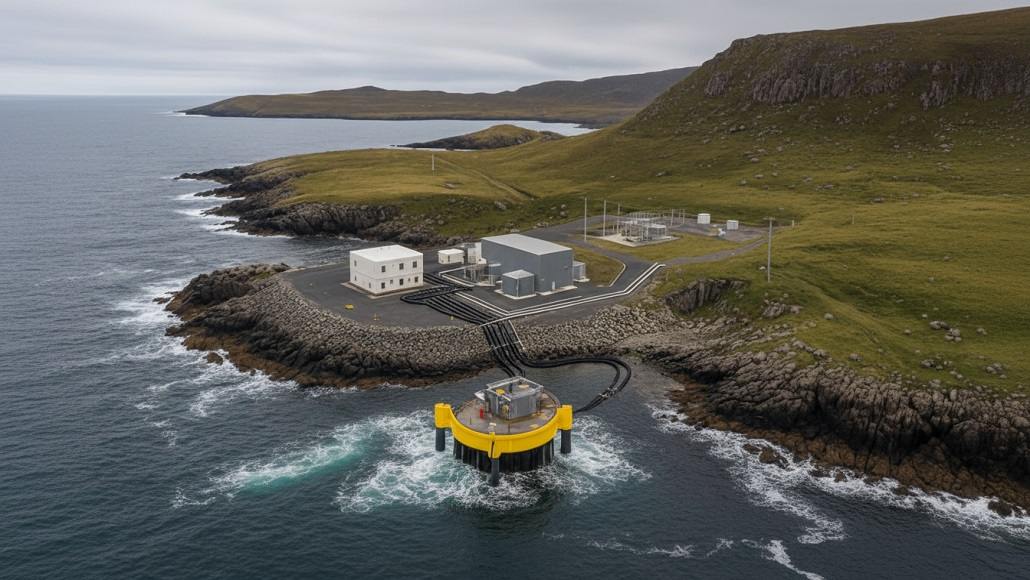
The European Marine Energy Centre (EMEC) has successfully completed a world-first demonstration integrating tidal power, battery and hydrogen systems, bringing together generation, storage, and hydrogen production within a single coordinated energy platform. The trial combined Orbital Marine Power’s O2 tidal turbine, vanadium flow batteries from Invinity Energy Systems, and a 670-kilowatt electrolyzer supplied by ITM Power. Testing took place at EMEC’s accredited research site on the island of Eday in Scotland’s Orkney Archipelago, a globally recognized hub for clean-energy innovation. Graeme Harrison, head of marine energy at Highlands and Islands Enterprise, said the Scottish Government and HIE were pleased to support the deployment of innovative technologies that enabled the landmark demonstration.
Although each technology has previously been tested independently, the recent demonstration marked the first time they were operated as a fully integrated tidal power, battery and hydrogen system capable of balancing variable tidal generation, storing surplus electricity, and producing green hydrogen when required. Leonore Van Velzen, EMEC’s operations and maintenance manager, said the project represented the culmination of years of work to link tidal energy, long-duration storage, and hydrogen production into a seamless operational framework, delivering practical insights into system integration.
During the trial, multiple energy-flow scenarios were assessed. Power from the O2 turbine was directed to charge the battery system and supply electricity directly to the electrolyzer during periods of strong tidal output, with excess energy exported to the grid. When tidal generation dropped, stored battery power was discharged to keep the electrolyzer running, smoothing the natural variability of tidal cycles. Battery energy also supported operations at EMEC’s onshore Caldale site, demonstrating additional flexibility.
EMEC said the integrated approach could help ease future grid constraints, open new hydrogen offtake opportunities, and support more resilient renewable energy systems. The trial also tested the system’s rapid response to an electrolyzer trip, avoiding a full site shutdown. While confirming the technical viability of the integrated setup, the work highlighted areas for further development, including battery management, electrolyzer controls, and automation. The demonstration formed part of the Interreg North-West Europe-funded ITEG project and received additional support from the EU-backed FORWARD2030 programme.