

















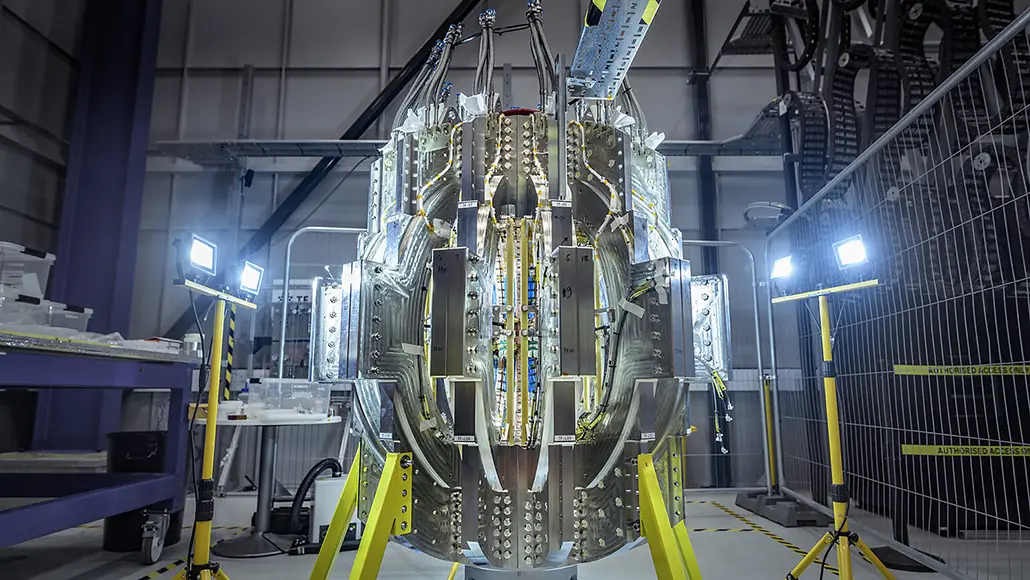
Tokamak Energy, which is based out of the UK, has recorded quite a prominent breakthrough when it comes to the development of clean energy through successfully replicating the fusion power plant fields in its Demo4 magnet system.
This is the very first time in the world that such kinds of fields are going to be created in a full High Temperature Superconducting magnet with HTS configuration.
In the recent tests that have been conducted at the headquarters of the company near Oxford, the Demo4 system attained magnetic field strengths of 11.8 Tesla with a temperature of -243 degrees Celsius, which is equivalent to 405.4 degrees Fahrenheit.
The system, which has a complete set of high temperature superconducting magnet is built in a tokamak configuration, successfully went on to manage seven million ampere-turns of electrical current by way of its central column.
Tokamak Energy’s CEO Warrick Matthews went on to describe the results as a major victory for the sector.
He said that Demo4 goes on to represent more than a decade of HTS innovation at Tokamak Energy. Cropped up from their fusion mission, it goes on to validate one of the technical solutions so as to get clean, safe, and limitless as well as secure fusion energy on the grid.
Validating the system-level performance
It is well to be noted that creating fusion energy needs very strong magnetic fields in order to confine as well as control hydrogen fuel that is heated to a plasma state many times hotter vis-à-vis the core of the sun. While the single high-field HTS magnets have already been demonstrated, Demo4 goes on to address the next critical engineering challenge, which is validating an overall magnet system.
When it comes to an operational fusion power plant, superconducting tapes have to operate within a very intricate magnetic environment, which gets created due to neighboring coils. These conditions prominently influence the structural performance as well as critical current.
Demo4 enables the engineers to generate and also study these fusion-relevant forces all throughout a system coil set that includes 14 toroidal field magnets along with a couple of poloidal field magnets.
Demo4 chief engineer, Graham Dunbar, went on to note that the platform is indeed offering very unique engineering data so as to inform the future power plant designs.
According to Dunbar, this is not only about getting to a number, but it is more about gaining the confidence as well as building expertise in order to scale their technology for future energy-producing fusion systems.
Commercial applications that go beyond fusion
The tests also underscored the commercial potential when it comes to HTS technology for sectors that are outside of the fusion energy gamut.
Apparently, HTS materials can go ahead and deliver almost 200 times the present copper density, thereby making them much more viable in terms of power distribution across data centers, magnetic levitation transport systems, and electric motors for zero-emission flight.
As per the company, these magnets can very well be made much smaller as well as lighter as compared to the traditional low-temperature superconductors and also function at a fraction of the cooling expense.
Tokamak Energy went on to indicate that more testing in order to reach higher magnetic fields is currently ongoing, with the next set of outcomes most likely anticipated in early 2026.
The high-speed plasma imagery
In another related development, the firm in the past had released the first high-speed color images of plasma that were captured inside a fusion energy machine, therefore offering some fresh visual insights when it comes to the behavior of the fuel.
This research also goes on to support the advancement of the X-point radiator – XPR regimes, which is also a promising operating mode for the fusion power plants of the future. XPR regimes are designed in order to cool the edge of the plasma much before it contacts the reactor components, therefore decreasing the wear on the hardware and not compromising on the performance.
The capacity to visualize how lithium goes on to interact with the plasma in real-time goes on to serve as a major step in terms of validating this enabling tech.